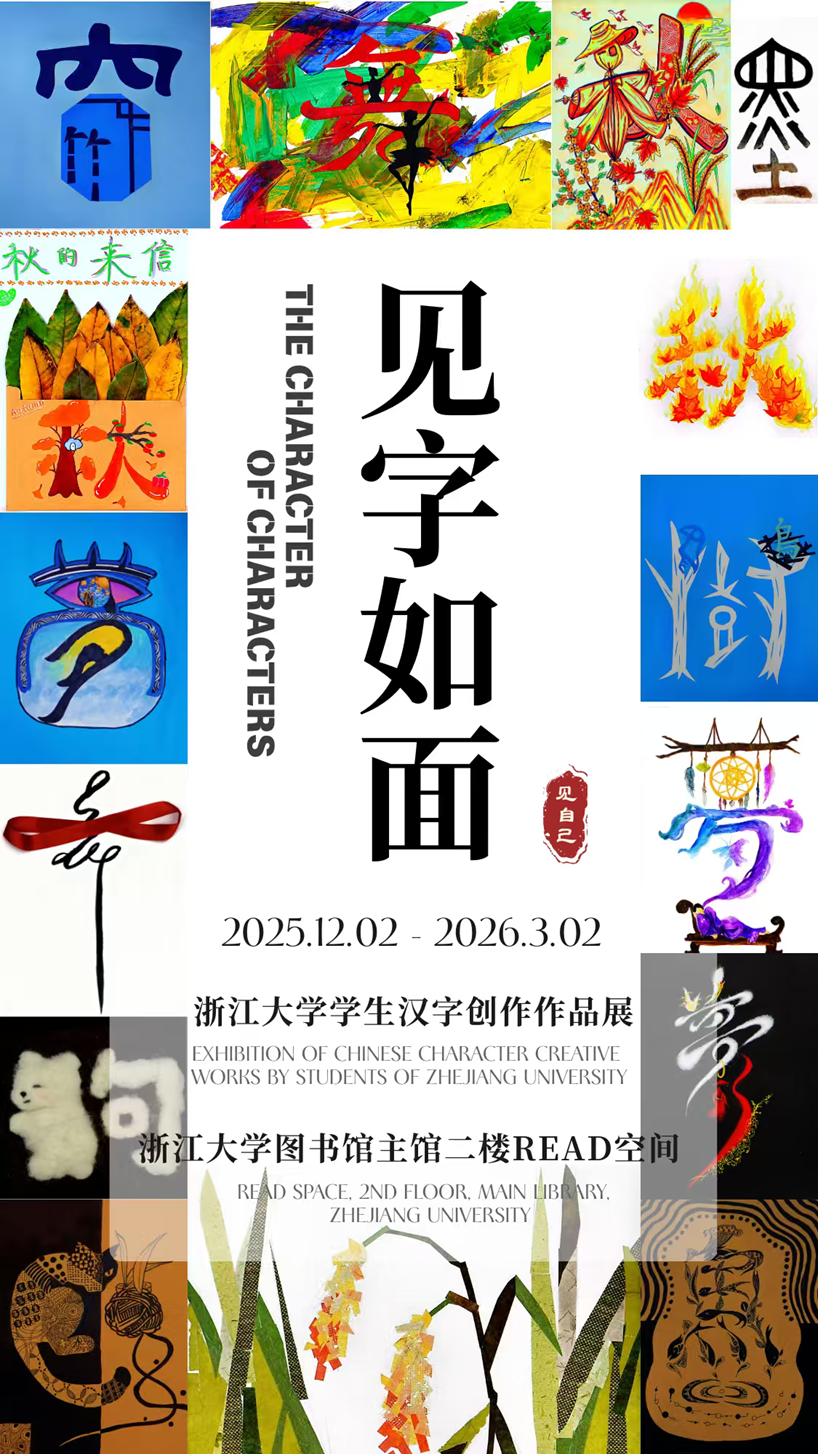
On 3 December, the opening ceremony for ‘Seeing Characters as Seeing the Person—Zhejiang University Student Chinese Character Creation Exhibition’ took place in the READ Space on the second floor of Zhejiang University Library. The exhibition was jointly initiated by the undergraduate course ‘Chinese Characters and Chinese Culture’ (lecturers: Zhang Liping and Gong Junji) and the postgraduate course "Research on Vocabulary Teaching and Acquisition in Chinese as a Second Language" (led by Gong Junji). Jointly organised by the School of Media and International Culture and the Zhejiang University Library, and co-hosted by the Department of International Cultural Studies, the Institute of Social Thought and International Culture, and the Institute of Aesthetics and Critical Theory, the exhibition showcases creative Chinese character works by 166 students from China and abroad. The opening ceremony was attended by Mr Bernard Le Sain, renowned French sinologist, former Chief Inspector of Chinese Language for the French Ministry of National Education, and Professor at the National Institute for Oriental Languages and Civilisations; Mr Wang Jue, Researcher at the University of Geneva; and Ms Wang Yuan, Secretary of the Party Committee of Zhejiang University Library.

In her address, Wang Yuan fully acknowledged the significant importance of this exhibition for disseminating Chinese culture. She stated that as a vital platform for campus cultural exchange, the library is most willing to provide whatever support it can for exhibitions related to such courses, thereby fully leveraging the library's role as a key platform for campus cultural exchange. This exhibition brings together creative works on Chinese characters by Chinese and multinational students, reflecting the convergence of diverse cultures at Zhejiang University and serving as a cross-cultural dialogue on Chinese characters. The library will continue to support related cultural exhibitions and promotional activities, aiding the dissemination of Chinese character culture both within and beyond the campus, extending to broader international spheres.
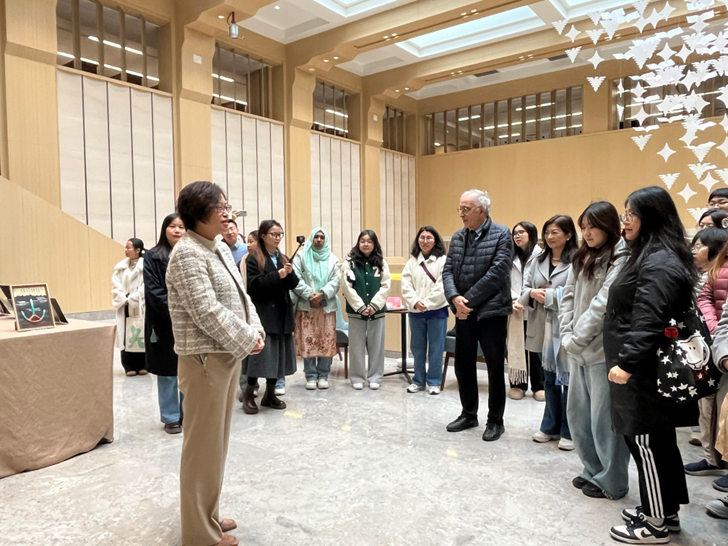
In his opening address, Mr Bai Lesang spoke highly of the quality and distinctive features of the Chinese character works showcased in this exhibition, as well as the creativity and profound interpretation of Chinese character culture demonstrated by both Chinese and international student artists. He referenced the "Drawing Chinese Characters" initiative he championed in France in 2011 and the subsequent Chinese Character Festival launched in Paris, expressing his hope that such events would dismantle cultural barriers to understanding Chinese characters, enabling more people to engage with them through visual and experiential approaches. He emphasised that Chinese characters represent the most fundamental element of Chinese culture, belonging not only to China but to Asia and indeed to all humanity as a shared cultural heritage.
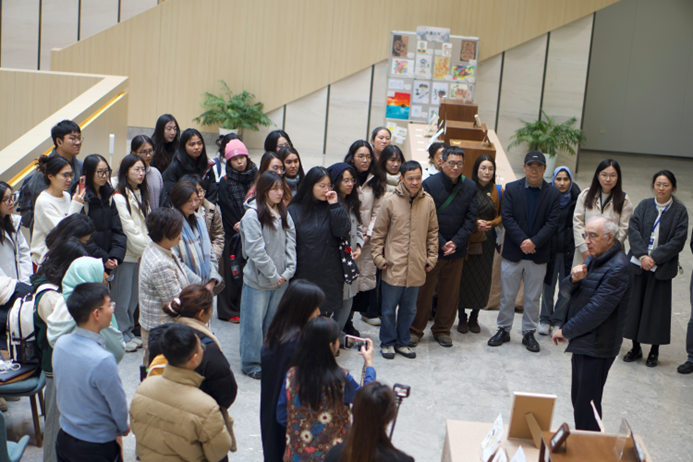
Gong Junji explained that the inspiration for this exhibition stems directly from the 'Drawing Chinese Characters' creative education project initiated by Professor Bai Lesang during the 2011 'China-France Year of Languages'. Over a decade later, having moved from Paris to Hangzhou, she collaborated with Zhang Liping as a lecturer at Zhejiang University to curate this experimental exploration of free Chinese character creation. This concept has been implemented within Zhejiang University's curriculum, where it continues to evolve and flourish.
This exhibition brings together over three hundred works by 166 students from China and across the globe. Using brushes, paper, collage materials, natural elements and other creative mediums, they have composed imagery and colour to re-energise Chinese characters – whether arranged in three-dimensional rows, rendered as pictorial imagery, imbued with narrative, or transformed into ornamentation. The inherent poetic, aesthetic, symbolic, combinatorial, and playful qualities of Chinese characters are reignited through this generation of creators, revealing the boundless potential for visual art rooted in the unique nature of Chinese script.
The exhibition "Seeing Characters as Faces: Zhejiang University Student Chinese Character Creations" comprises six distinct sections. Five are organised by thematic focus and stylistic characteristics of coursework submissions: "Realms of the Fingertips", "Between Ink and Colour", "Landscapes in Characters", "Implied Meanings", and "Great Truths in Small Words". Additionally, a dedicated section titled "Universal Language, Universal Vision" showcases selected works from the "Painting Chinese Characters" event at the Paris Chinese Character Festival. Here, French creators interpret Chinese characters and culture through brush and pigment, expressing their distant perceptions of the script and the Orient. In this moment, Chinese characters bridge China and the world, where cultures converge in diverse harmony.
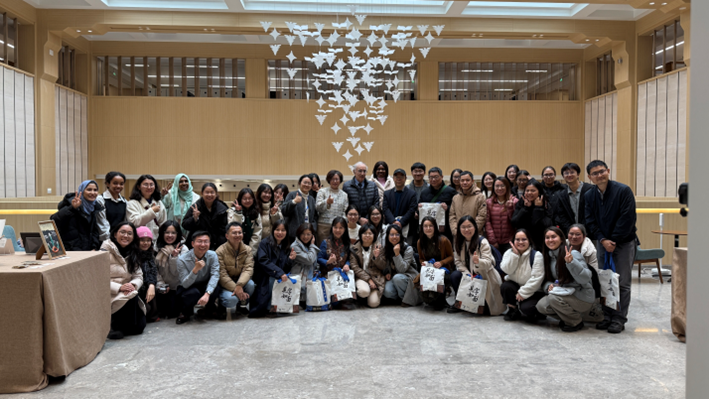
As the opening ceremony drew to a close, all guests and student representatives gathered before the exhibition's thematic wall for a commemorative photograph, capturing this precious moment of cultural convergence. Subsequently, teachers and students proceeded into the exhibition space to immerse themselves in the artistic allure of Chinese characters.
During the tour, students shared their interpretations of the works, while teachers paused frequently to offer commentary, discussing the preservation and innovation of Chinese character culture. Shortly after the exhibition opened, numerous students had already penned moving remarks on the message board, expressing astonishment at their peers' imagination and creativity, alongside their admiration for Chinese character culture and the exhibition itself.
"Seeing Characters as Seeing People: Zhejiang University Students' Chinese Character Creation Exhibition" centres on the core concept of "Seeing characters, seeing people, ultimately seeing oneself." It is not merely a visual feast but a collective exploration of language, perception, thought, and creativity. Running for three months, the exhibition invites visitors to experience the profound heritage of Chinese civilisation through the fluidity of brush and ink, and to appreciate the enduring charm of Chinese characters amidst cross-cultural encounters.